
Melasma treatment in Korea
Pigment is assessed by depth before any device is chosen. The aim is a course that clears without leaving the skin darker than it started.
Getting melasma treated in Korea
Examination first, passport onlyMelasma is a medical condition rather than a cosmetic blemish, and it is treated here as one. The first appointment is an examination, not a treatment slot. What is being established is what kind of pigment is present, roughly how deep it sits, and what has already been done to it, because previous over-treatment changes what is safe to do next.
For visitors the practical requirements are short. Bring a passport. Korean national health insurance is not required and does not cover melasma treatment in any case, so residents and visitors are quoted the same private rate. Consultation is in English. If you have had laser treatment elsewhere, bring whatever record you have of what was used, including device names and how many sessions.
Why aggressive treatment makes melasma worse
Post-inflammatory hyperpigmentation is the main riskThe instinct with stubborn pigment is to raise the power. With melasma that instinct is usually wrong. Above a certain threshold the skin’s inflammatory response produces new pigment of its own, and the result is post-inflammatory hyperpigmentation: the area is darker at two to four weeks than it was before treatment, and the border spreads. Asian skin reaches that threshold sooner than lighter skin types.
This is why a course here is built around the interval and the endpoint rather than the intensity, and why the two weeks after a session are treated as part of the treatment. Dr. Yoon presented on precisely this point to the Korean Society for Cosmetic Dermatological Surgery in 2018, under the title Skin care after laser matters more than the laser.
The practical consequence for a patient is unwelcome but honest: a course that is working may look slow. Pigment that lightens gradually over several weeks is a better outcome than pigment that clears in one session and rebounds darker in the second month.
How the pigment is assessed
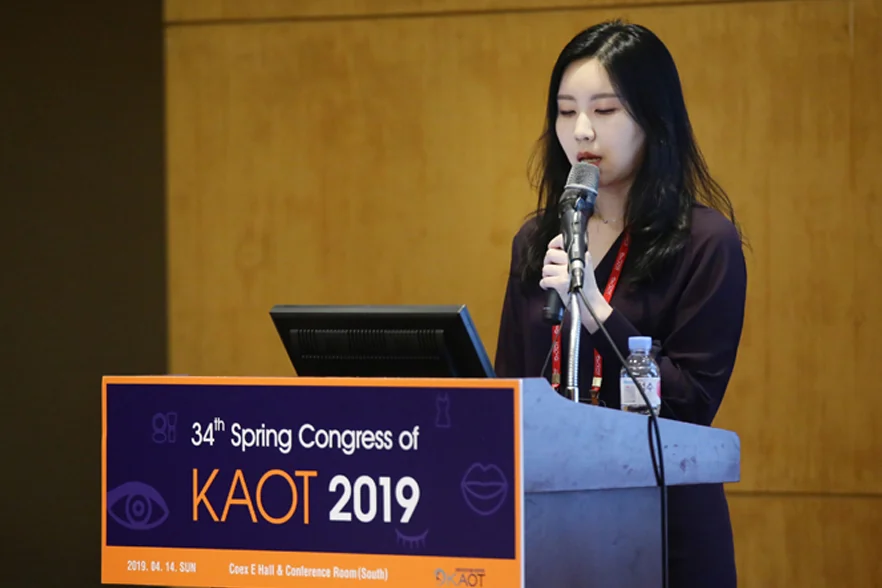
Dr. Yoon lectured on refractory pigmentary disorders and the role of the basement membrane at the 2019 spring congress of the Korean Society for Laser Dermatology and Trichology. The assessment below follows that approach.
Type
Melasma, solar lentigines, post-inflammatory pigment, and ochronosis from long-term hydroquinone all look brown and are not treated the same way. They are separated first.
Depth
Epidermal, dermal, or mixed. Epidermal pigment responds; dermal pigment responds slowly and punishes impatience. Most melasma is mixed, which is why results are uneven across one face.
Barrier condition
Skin that is already inflamed, thinned by steroid creams, or mid-flare from rosacea is not treated on the day. Treating a compromised barrier is how a course goes backwards.
Drivers
Oral contraception, pregnancy, thyroid disease, occupational heat exposure, and sun habit. Clearing pigment without touching the driver produces a short remission.
Equipment used
Genuine consumables onlyClarity II (Lutronic). The current generation of the Clarity series, used here for clear toning and Alexandrite toning depending on the depth of the target. Toning is deliberately sub-threshold: the intent is repeated low-energy passes rather than a single aggressive one.
Virtue RF. Microneedling radiofrequency, FDA cleared, used where the pigment sits alongside texture change or scarring rather than on its own.
Medical peels. PHA-based peeling, which hydrates rather than strips, used as an adjunct where the barrier will not tolerate light-based treatment yet.
The clinic uses manufacturer-supplied consumables only. For handpieces and tips that are sold as single-use, counterfeit and refilled parts are a real problem in this market and they change the energy actually delivered to your skin.
What a course looks like
Reviewed, not run to a fixed countA typical course runs as low-energy sessions one to two weeks apart with a review point built in, usually after the second or third session. At the review the question is not whether to continue but whether the approach is right: pigment that has not moved at all, or that has darkened, means the plan changes rather than repeats.
Topical treatment and sun protection run alongside from day one and continue after the course ends. This is the part patients most often drop, and it is the part that determines whether the result lasts through the following summer.
Follow-up can continue by message once you have left Korea. Photographs under consistent lighting are more useful than a description.
If you are visiting for a short time
A week is not a course. What it can realistically produce is an assessment you can act on: what type of pigment you have, how deep it sits, what has been done to it already, and specifically what should not be done to it next. For patients who have cycled through several clinics without improvement, that is often worth more than another two sessions.
If you do want treatment during a short visit, the sessions are planned around your departure date, because the two weeks after a session are when post-inflammatory pigment appears and you should not be at 35,000 feet with no way to be seen.
Frequently asked
Can melasma be cured?
It is managed rather than cured. Melasma is driven by hormones, ultraviolet light, and heat as well as by the pigment already in the skin, so the pigment can be cleared and then return if the drivers are not addressed. A clinic that promises permanent removal is describing something the condition does not do.
Why did my melasma get darker after laser treatment?
Most often post-inflammatory hyperpigmentation. If the energy delivered exceeds what the skin will tolerate, the inflammatory response itself produces new pigment, and the area looks worse at two to four weeks than it did before. Asian skin is more prone to this than lighter skin types, which is why settings validated elsewhere are not transferred unchanged.
How is melasma different from freckles or sun spots?
Freckles and sun spots are small, well defined, and sit near the surface, so they respond quickly. Melasma is broad, has a blurred edge, is usually symmetrical across both cheeks, and frequently sits deeper. Treating melasma as though it were a sun spot is the most common reason a course fails.
How many sessions does it take?
It depends on the depth and on how the skin responds to the first two sessions, so a number quoted before an examination is a guess. Toning courses are typically spaced one to two weeks apart and reviewed rather than run to a fixed count. If there is no change by the review point, the approach is changed instead of repeated.
Can I have melasma treatment while visiting Korea for a week?
One or two sessions can be done, and a home regimen can be set up, but a week is not enough to complete a course. What a short visit is genuinely useful for is assessment: establishing what type of pigment you have and what should and should not be done to it, which you can then continue at home.
Do I need Korean health insurance?
No. Registration takes a passport. Melasma treatment is not covered by Korean national health insurance in any case, so residents and visitors pay the same private rate.
What happens if I stop sun protection?
The pigment returns, usually faster than it cleared. Ultraviolet light and visible light both stimulate melanocytes, and heat does too, which is why the summer months and hot yoga and cooking over a grill all matter. Sun protection is part of the treatment, not an accessory to it.
Is treatment painful?
Toning is usually described as a series of warm snaps rather than pain, and no anaesthetic is normally needed. Deeper resurfacing is different and is discussed separately if it is proposed.
Ask about your pigment
Tell us what has already been done to your skin and when you are in Seoul. We reply within one business day.